
Balancing Code and Cognition: The Human Side of AI
AI is reshaping engineering, but success isn’t just about technology. This post shows how human insight, creativity, and collaboration drive reliable software while balancing code, cognition, and ethical judgment.
Jagrit Gyawali
12/4/20252 min read
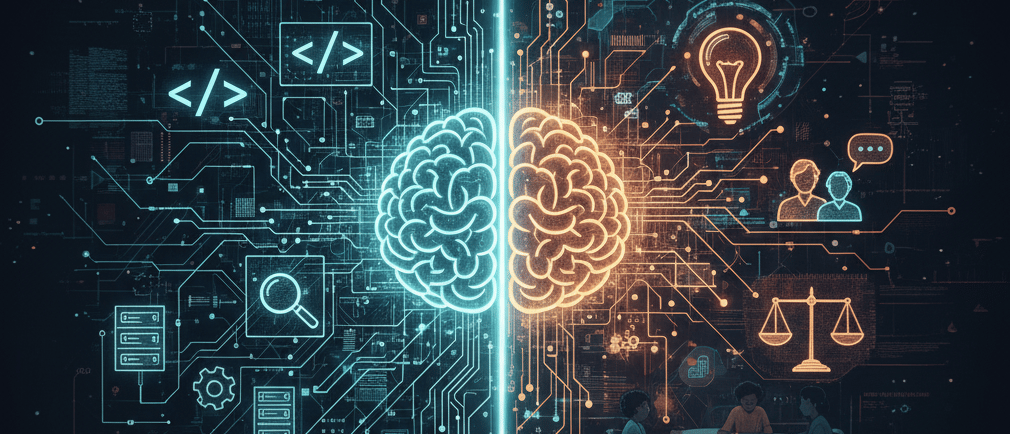
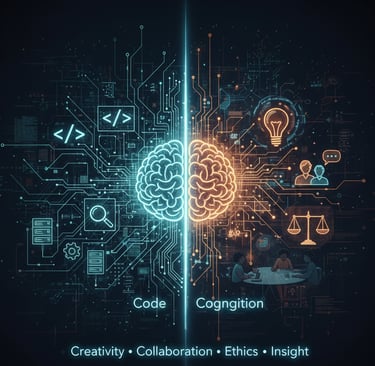
AI is transforming engineering across the board, from software development to quality assurance, infrastructure, and product design. Tools that generate code suggestions, optimise workflows, or detect anomalies are becoming routine. But amid this automation, one element remains irreplaceable: the human mind. Decisions, creativity, collaboration, and ethical judgment are uniquely human qualities that determine whether AI is a tool or a crutch. For engineering teams, understanding the human element of AI isn’t optional, it’s essential.
1. Psychology & Behaviour in AI-Augmented Teams Humans bring intuition, context, and critical thinking to technical work. Cognitive biases like overreliance on AI recommendations or confirmation bias, can influence decisions in ways automation cannot correct. Recognising these tendencies is crucial.
For example, a developer might accept an AI-generated code snippet without fully considering edge cases, or a QA engineer may assume a passing automated test guarantees reliability. Human insight, informed by experience and collaborative discussion, catches these blind spots. Creativity, empathy, and curiosity are the qualities AI cannot replicate, yet they drive innovation in engineering teams.
2. Agile Teams & Structure AI changes not only tools but team dynamics. Roles evolve: engineers become problem-solvers and strategists rather than just coders, while QA engineers shift from manual testers to orchestration and analysis roles. Team leads must balance human judgement with machine recommendations, while communication patterns adapt with stand-ups and planning focusing more on strategic discussion and risk assessment than task reporting.
Trust in AI is critical, but so is trust in each other. Teams that integrate AI successfully see efficiency gains without losing accountability, collaboration, or innovation.
3. Evidence & Industry Insights Studies suggest AI can accelerate testing and code review cycles by 30–40% in some contexts. The most successful teams integrate AI as a collaborator, not a replacement. Human oversight ensures context, prioritisation, and ethical decision-making.
Across engineering domains, combining AI efficiency with human insight reduces defects, improves reliability, and boosts team engagement.
4. Forward-Looking Predictions Over the next 5–10 years, AI will increasingly handle repetitive tasks, predictive maintenance, testing, and even code generation. The human role will shift toward leadership, ethical oversight, and complex problem-solving.
“AI fluency” will become essential for engineers and leaders alike: understanding capabilities, interpreting outputs, and guiding teams to combine machine efficiency with human judgement. Ethical considerations, cognitive load, and bias mitigation will be core responsibilities.
5. Practical Takeaways
Treat AI as a collaborator, not a replacement. Encourage teams to question and validate outputs.
Foster psychological safety: allow engineers to challenge AI results and discuss edge cases openly.
Invest in AI fluency for all engineers and leaders.
Maintain rituals that prioritise human insight: retrospectives, peer reviews, and creative problem-solving sessions.
Recognise that AI augments human work; it does not replace creativity, ethics, or collaboration.
In Summary, AI is reshaping engineering, including QA, development, and infrastructure. But humans remain the critical element. Creativity, collaboration, ethical judgment, and strategic thinking ensure AI is used effectively and responsibly. Teams that master the balance between code, cognition, and insight will thrive in the AI-driven future.
Contact
Reach out for tailored quality coaching.
Phone
+447979102765
© 2025. All rights reserved.
Stay Informed
Get updates on workshops and coaching tips